


The iPhone 16 and Galaxy Z Flip7 take different paths through price, hardware, camera priorities, and ecosystem extras.
This comparison breaks down price, design, display, performance, camera, battery, software, storage, transfer, and final buyer value so you can see where each phone actually leads.
TL;DR: The iPhone 16 is the better value pick because it gives you lower starting price of $799, 12MP TrueDepth front camera, smaller footprint, and MagSafe/Qi2.
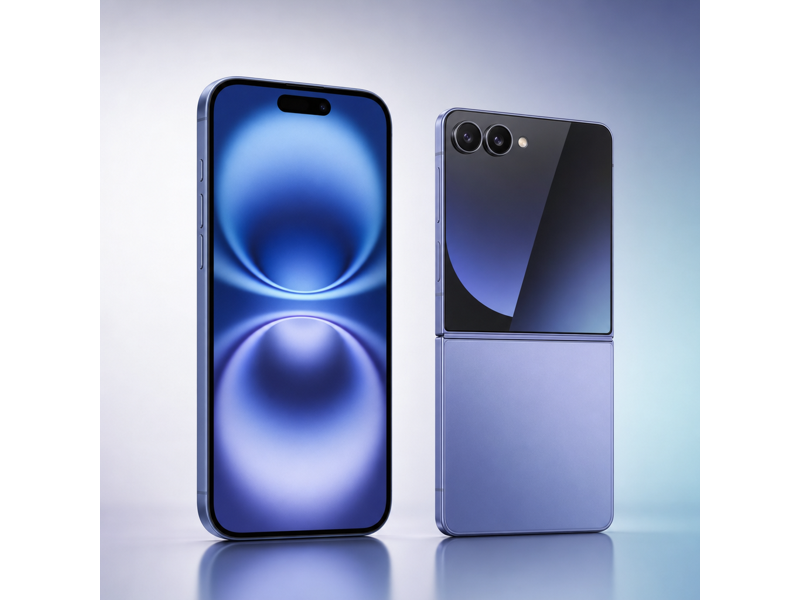
iPhone 16 vs Galaxy Z Flip7 Specs Table
The specs table below highlights the exact launch-price, size, display, chip, camera, battery, USB, and connectivity differences between iPhone 16 and Galaxy Z Flip7 before the section-by-section breakdown.
| Specifications | iPhone 16 | Galaxy Z Flip7 |
|---|---|---|
| Starting Price | $799 | $1,099.99 |
| Dimensions | 5.81 x 2.82 x 0.31 in | Unfolded 6.56 x 2.96 x 0.26; Folded 3.37 x 2.96 x 0.54 in |
| Weight | 170 g | 188 g |
| Processor | A18 | Exynos 2500 |
| Storage | 128GB, 256GB, 512GB | 256GB / 512GB |
| Display | 6.1 in (Super Retina XDR OLED) | 6.9 in main; 4.1 in cover (Foldable Dynamic AMOLED 2X main; Super AMOLED cover) |
| Resolution | 2556 x 1179 | 2520 x 1080 main; 1048 x 948 cover |
| Connectivity | 5G, Wi-Fi 7, Bluetooth 5.3, Thread, NFC, Ultra Wideband | 5G, LTE, Wi-Fi 7, Bluetooth 5.4, NFC |
| Rear Cameras | 48MP main + 12MP ultrawide | 50MP main + 12MP ultrawide; no dedicated telephoto |
| Front Camera | 12MP TrueDepth | 10MP |
| Battery | Up to 22 hours video playback | Up to 24 hours video playback |
| USB | USB 2 | USB-C, USB 3.2 |
| Colors | Ultramarine, Teal, Pink, White, Black | Jet Black, Blue Shadow, Coral Red, Mint |
iPhone 16 vs Galaxy Z Flip7: Price
The iPhone 16 starts at $799, while the Galaxy Z Flip7 starts at $1,099.99. That creates a launch-price gap of $300.99.
The premium only makes sense if you specifically want stronger rear camera setup, up to 24 hours of video playback, larger display, and smoother 120Hz display from the Galaxy Z Flip7. If not, the iPhone 16 keeps the cleaner value case.
 Winner: iPhone 16
iPhone 16 vs Galaxy Z Flip7: Design
The iPhone 16 measures 5.81 x 2.82 x 0.31 in and weighs 170 g, while the Galaxy Z Flip7 comes in at Unfolded 6.56 x 2.96 x 0.26; Folded 3.37 x 2.96 x 0.54 in and 188 g.
iPhone 16 wins on design because it gives you smaller footprint.
Winner: iPhone 16iPhone 16 vs Galaxy Z Flip7: Display
The iPhone 16 offers 6.1 in, 2556 x 1179, and 60Hz, while the Galaxy Z Flip7 counters with 6.9 in main; 4.1 in cover, 2520 x 1080 main; 1048 x 948 cover, and 1-120Hz adaptive.
Galaxy Z Flip7 takes the display section because it delivers a larger 6.9 in main; 4.1 in cover screen and a smoother 120Hz-class panel.
Winner: Galaxy Z Flip7iPhone 16 vs Galaxy Z Flip7: Performance
On paper, the iPhone 16 runs A18, while the Galaxy Z Flip7 runs Exynos 2500. Transfer support also matters: iPhone 16 uses USB 2, and Galaxy Z Flip7 uses USB-C, USB 3.2.
There is no meaningful performance difference here for most buyers, so this section stays a tie instead of pretending one side has a practical speed lead.
Winner: TieiPhone 16 vs Galaxy Z Flip7: Camera
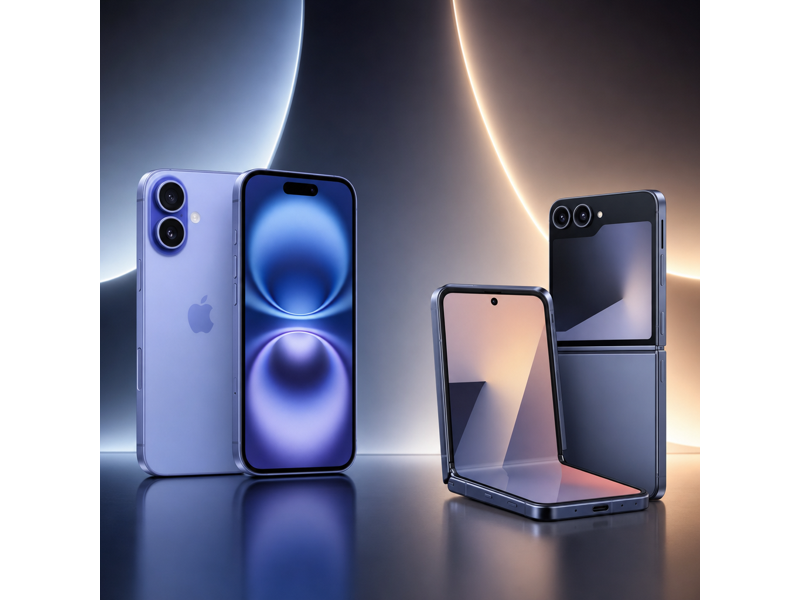
The iPhone 16 uses 48MP main + 12MP ultrawide on the back plus a 12MP TrueDepth front camera. The Galaxy Z Flip7 counters with 50MP main + 12MP ultrawide; no dedicated telephoto and a 10MP selfie camera.
The Galaxy Z Flip7 has the stronger rear camera setup because of the better overall rear-camera hardware mix. The iPhone 16 has the upgraded 12MP TrueDepth front camera. The Galaxy Z Flip7 also has the better video-workflow angle because it offers USB-C, USB 3.2. That creates a real tradeoff rather than a total camera sweep from one side. Overall, the Galaxy Z Flip7 takes the camera section once rear-camera flexibility, front-camera hardware, and video-workflow practicality are weighed together.
 Winner: Galaxy Z Flip7
iPhone 16 vs Galaxy Z Flip7: Battery
Apple lists the iPhone 16 at Up to 22 hours video playback. Samsung lists the Galaxy Z Flip7 at Up to 24 hours video playback.
Galaxy Z Flip7 gets the battery win because its quoted video-playback figure is higher, giving it the stronger paper endurance claim.
Winner: Galaxy Z Flip7iPhone 16 vs Galaxy Z Flip7: Software, Storage, and Features
The iPhone 16 offers storage up to 512GB, plus 5G, Wi-Fi 7, Bluetooth 5.3, Thread, NFC, Ultra Wideband. The Galaxy Z Flip7 reaches up to 512GB, plus 5G, LTE, Wi-Fi 7, Bluetooth 5.4, NFC.
Galaxy Z Flip7 wins this section because it gives you USB 3 and Wireless PowerShare.
Winner: Galaxy Z Flip7Switching to a New Phone? Use MobileTrans to Transfer Your Data
If you are moving between the iPhone 16 and Galaxy Z Flip7 , the practical challenge is not just choosing a winner. It is also making sure your photos, videos, messages, contacts, and app data move over cleanly without wasting time.
That is where MobileTrans - Phone Transfer can help. It is useful whether you are jumping from iPhone to Samsung, Samsung to iPhone, or just setting up a second device while keeping your files organized.




How to transfer data using MobileTrans
If you decide to upgrade to either model, moving your data can be quick and simple with MobileTrans.
Step 01
Connect Your Phones
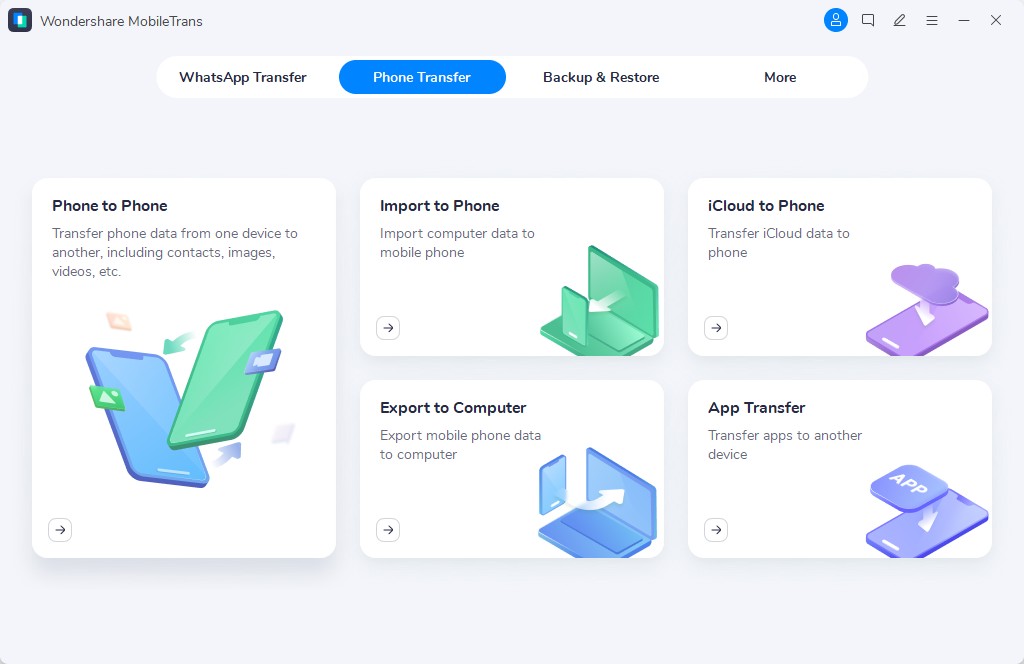
Install MobileTrans on your computer, then click the Phone to Phone tab and connect both Phones via USB.
Step 02
Choose What to Transfer
Select the data you want to move, such as contacts, photos, messages, videos, and other important files.
Step 03
Start the Transfer
Click the transfer button and wait for the process to finish. Once done, check your new phone to make sure everything has been copied successfully.


iPhone 16 vs Galaxy Z Flip7: Which One Should You Buy?
Choose the iPhone 16 if you want lower starting price of $799, 12MP TrueDepth front camera, smaller footprint, MagSafe/Qi2, and lighter body.
Choose the Galaxy Z Flip7 only if you specifically care more about stronger rear camera setup, up to 24 hours of video playback, larger display, and smoother 120Hz display than about the broader all-around hardware case.
Winner: iPhone 16Final Verdict
Final verdict: the iPhone 16 wins this comparison because it gives you lower starting price of $799, 12MP TrueDepth front camera, smaller footprint, MagSafe/Qi2, and lighter body.
The Galaxy Z Flip7 still matters if you specifically want stronger rear camera setup, up to 24 hours of video playback, larger display, and smoother 120Hz display, but the value scoring here favors the iPhone 16.